Solar Sails by Giovanni Vulpetti Les Johnson & Gregory L. Matloff
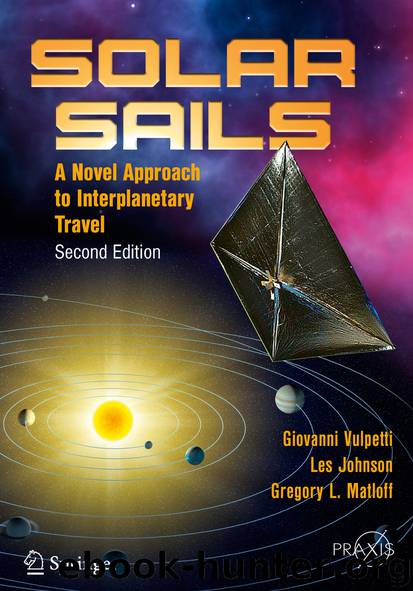
Author:Giovanni Vulpetti, Les Johnson & Gregory L. Matloff
Language: eng
Format: epub
Publisher: Springer New York, New York, NY
The primary payoff of the UltraSail would be the elimination of the truss structures inherent in most of the sail systems proposed and tested to date. This would significantly reduce the overall areal density, allowing gossamer sails of 1 g/m2 to be fielded. As humanity’s space-faring technology and inspace infrastructure mature, we can expect many improvements in sail design and construction. Some of these improvements will be due to enhanced capabilities to deposit thin films in the high-vacuum, microgravity environment. Not to be ignored is the eventual possibility of constructing solar photon sails and associated equipment from materials found on the Moon and near asteroids, reducing the mass required to be launched from Earth. Finally, terrestrial materials technology will certainly improve, resulting in reduced sail areal density, stronger sails and cables, and high temperature-resistant sail materials.
One improvement might occur within a decade or so of the first operational solar photon-sail missions. First generation sails are generally tri-layered. Facing the Sun is a reflective layer, which is affixed to a plastic substrate. Among other things, the plastic substrate provides the structural strength required for the sail to survive the accelerations experienced during launch. On the anti-sunward side is an emissive layer that radiates the small fraction of incident sunlight that is absorbed by rather than reflected from the reflective layer. Some researchers have already conducted experiments with plastics that will evaporate when exposed to solar ultraviolet radiation. If this evaporation can be controlled in a large, thin-film structure, the areal density of Earth-launched sails will be greatly reduced.
Farther in the future, we may not only mine celestial bodies for solar sail raw materials; we may also utilize the dynamic properties of these objects. Consider, for example, the possibility of unfurling a Sun-sensitive plastic film on the “night side” of an asteroid or comet. Then, using the process of vacuum-phase deposition, which allows the deposition atom by atom of nanometer-thin metallic films, a metallic reflective layer is built up on the plastic substrate. Finally, the completed structure is maneuvered into sunlight. The plastic layer evaporates, leaving only a hyperthin sail, which is now ready to roll. Furthermore, even the hyperthin metallic monolayer sail might be superseded. There are mass advantages to the perforated sail, in which perforations are smaller than a wavelength of light, or better, smaller than the shortest wavelength value of the (large) solar bandwidth that the sail’s material can efficiently utilize for propulsion.
Nevertheless, the concepts behind the above potentialities belong, in a certain sense, to past physics and to the ways of using it. One could wonder, what about tomorrow? Might there be any scientifically imaginable turning point that renders space sailing much more attractive than is now conceivable? In the previous chapters, we have dealt with a few pieces of such topics; in the next two sections, we discuss realistic scientific answers.
Download
This site does not store any files on its server. We only index and link to content provided by other sites. Please contact the content providers to delete copyright contents if any and email us, we'll remove relevant links or contents immediately.
Whiskies Galore by Ian Buxton(42084)
Introduction to Aircraft Design (Cambridge Aerospace Series) by John P. Fielding(33175)
Small Unmanned Fixed-wing Aircraft Design by Andrew J. Keane Andras Sobester James P. Scanlan & András Sóbester & James P. Scanlan(32835)
Aircraft Design of WWII: A Sketchbook by Lockheed Aircraft Corporation(32333)
Craft Beer for the Homebrewer by Michael Agnew(18288)
Turbulence by E. J. Noyes(8113)
The Complete Stick Figure Physics Tutorials by Allen Sarah(7424)
The Institute by Stephen King(7093)
The Thirst by Nesbo Jo(7005)
Kaplan MCAT General Chemistry Review by Kaplan(6990)
Bad Blood by John Carreyrou(6671)
Modelling of Convective Heat and Mass Transfer in Rotating Flows by Igor V. Shevchuk(6495)
Weapons of Math Destruction by Cathy O'Neil(6366)
Learning SQL by Alan Beaulieu(6345)
Man-made Catastrophes and Risk Information Concealment by Dmitry Chernov & Didier Sornette(6139)
Permanent Record by Edward Snowden(5892)
Digital Minimalism by Cal Newport;(5837)
Life 3.0: Being Human in the Age of Artificial Intelligence by Tegmark Max(5619)
iGen by Jean M. Twenge(5454)
